Google Search is now AI search. Here's what it means for your business
Google now treats search as AI search. Fewer people click the top result, and AI answers decide who gets seen. Here's what to do about it.
Key takeaways
- Google now treats AI as the core of Search, not an add-on. AI Mode passed one billion monthly users in its first year.
- New features let people search with photos, files and open tabs, set up agents that watch the web for them, and build small tools inside Search.
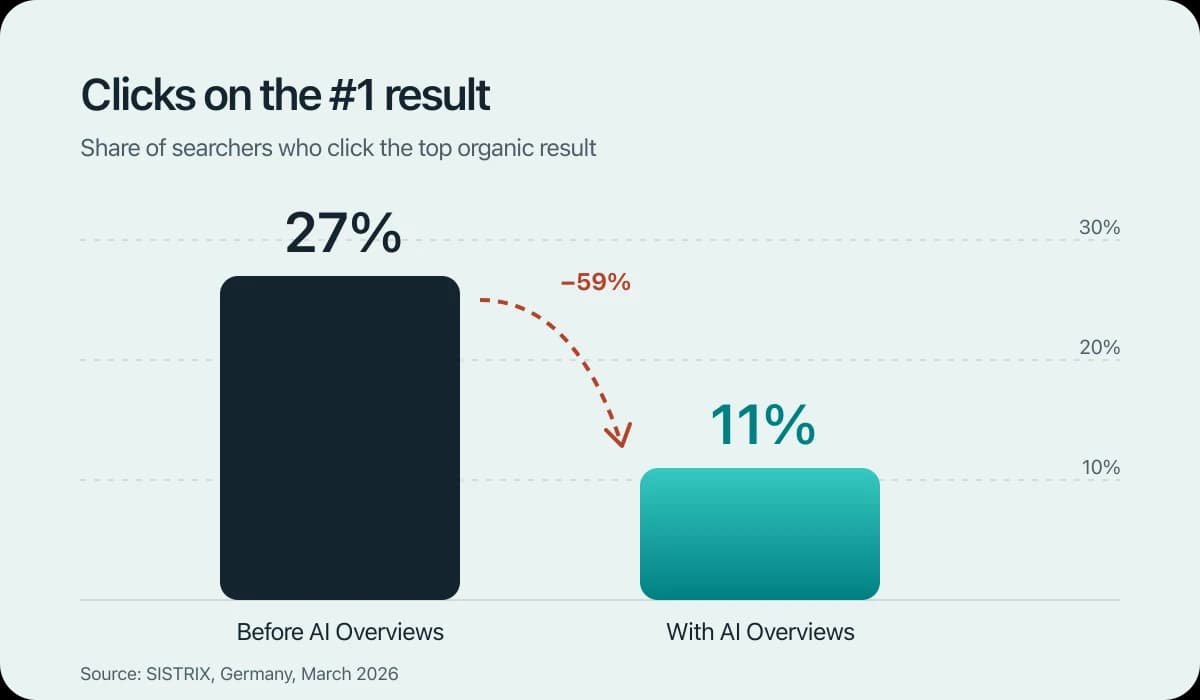
- Clicks on the #1 organic result fell from 27% to 11% in SISTRIX data from Germany, as AI answers took their place.
- Ranking still matters, but you also need to be the source the AI answer quotes.
- Clear, well-structured, genuinely expert content is what wins in both places.
For twenty-five years, searching on Google meant typing a few words and scrolling a list of blue links. That era is ending. At Google I/O 2026, Google's head of Search put it in one line: Google Search is AI search.
If you run a business in Ranchi, Patna, Kolkata or anywhere in India, this matters. Most of your new customers still find you through Google. What they see when they search, and whether they ever reach your website, is changing quickly. The good news is that you don't need to throw away what already works. You need to make sure it works in more places.
What Google announced
Google introduced three big changes that are rolling out across Search. Together they turn Search from a list of links into something closer to an assistant.
1. A smarter search box
Google calls it the biggest change to the search box in over 25 years. It grows to fit longer questions and accepts more than text: you can add a photo, a PDF, a video or even the tabs you have open in Chrome. Instead of autocomplete, it suggests what you might be trying to do. AI Overviews and AI Mode now live together in one place, powered by Google's Gemini models.
2. Information agents
These are assistants that keep watching the web after you've closed the tab. Ask one to follow a topic, such as new rules for GST filing or price drops on a product, and it checks news sites, blogs and social posts around the clock, then sends you a summary when something important changes. Think of Google Alerts, but one that reads and understands what it finds.
3. Agentic search
People can now build small custom tools right inside Search. Someone looking for a flat to rent can get a live tracker with filters and alerts. Someone following the stock market can get a monitoring dashboard. Search is no longer only handing out links. It is producing answers and tools.
Why your clicks are shrinking
The numbers already show the shift. AI Overviews reach around 2.5 billion people a month, and AI Mode crossed one billion monthly users within its first year. When the answer appears right on the results page, fewer people need to click.
Research firm SISTRIX measured what that does to traffic in Germany. The share of searchers clicking the #1 organic result dropped from 27% to just 11%. Similar patterns are showing up wherever AI Overviews appear regularly, and Indian searches are no exception.
Information agents push this further. They will deliver updates to people who never typed a search at all. Your content can now be read, summarised and passed on by Google without a visit to your website.
The good news: good SEO still works
It's tempting to treat every Google announcement as a reason to start from scratch. You don't need to. The things that have always made a website rank well are the same things AI search rewards:
- Clear expertise. Content written by people who know the subject, with real examples, prices, photos and results (Google calls this E-E-A-T: experience, expertise, authority and trust).
- Answering the actual question. Pages built around what the customer is trying to do, not just a keyword.
- A technically sound website. Fast, mobile-friendly, secure and easy for Google to crawl.
- A clear identity. Google should know exactly who you are, what you do and where you work, from your website, your Google Business Profile and other listings.
An information agent watching a topic will pick the sources that answer it best. Those sources win for the same reasons pages have always ranked: they are trustworthy, up to date and easy to understand.
Your new goal: rank and get cited
Visibility now has two parts. You want to appear in the normal results (including maps and your Google Business Profile), and you want to be one of the sources the AI answer quotes. These overlap, but they are not identical.
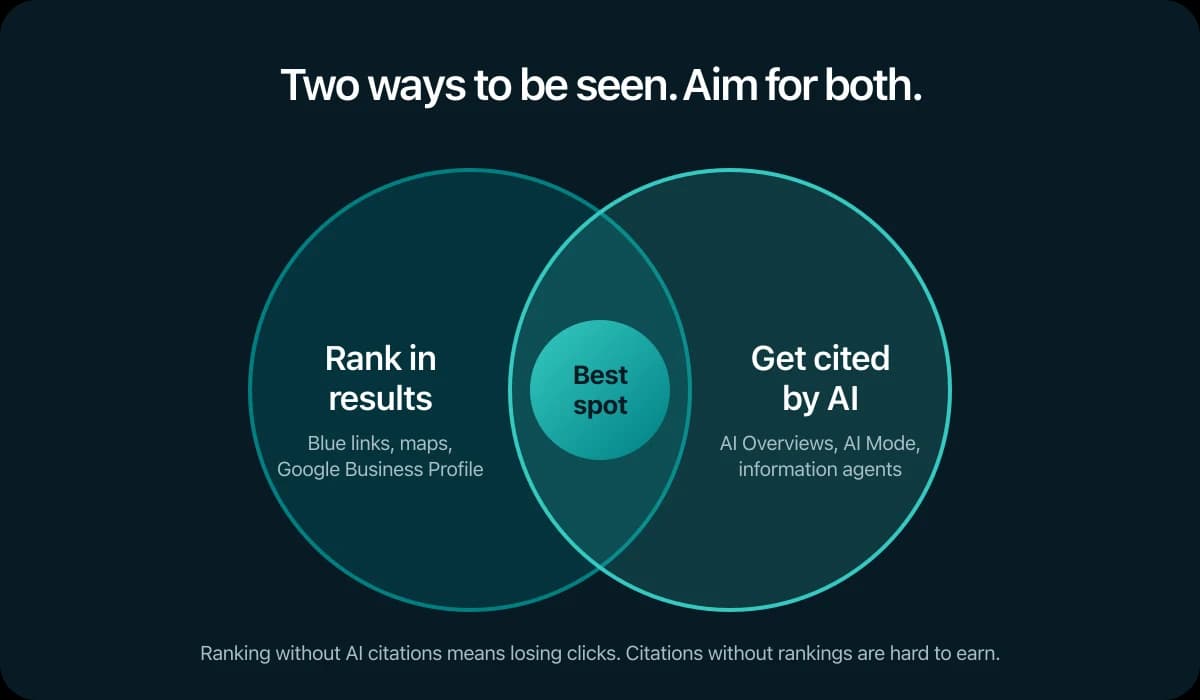
A page that ranks well and gets cited by AI is an asset. A page that ranks well but never appears in AI answers is slowly losing clicks. That's a risk worth fixing now, while competitors in your city are still catching up.
What to do now: a checklist
- Check whether AI can understand your key pagesPick your five most important pages, such as your homepage, main services and contact page. Could an AI write an accurate summary of your business from them? If prices, locations, services or opening hours are missing or vague, add them.
- Answer questions directlyStart important sections with a short, plain answer, then add detail. Add FAQ sections for the questions customers actually ask you on the phone and on WhatsApp.
- Add structured dataSchema markup tells Google exactly what's on a page: your business details, services, reviews, FAQs and articles. It is one of the easiest ways to make your content machine-readable.
- Publish things only you can sayGeneric articles that repeat what's already online won't be quoted. Share your own prices, local knowledge, project results, photos and opinions. Original information is what AI answers need sources for.
- Keep your Google Business Profile and listings in orderSame name, address and phone number everywhere, fresh photos, regular posts and replies to reviews. For local searches, this is often what gets surfaced first.
- Track AI visibility, not just rankingsSearch your main services in AI Mode and note whether your business is mentioned or linked. Treat it as a second report card alongside your rankings.
- Don't ignore other search enginesNot everyone is happy about AI-first search, and some people are moving to alternatives like Bing and DuckDuckGo. Make sure your site is listed and working well there too.
The bottom line
AI is now the main way people interact with Google. Blue links are becoming one result type among many, and more customers will get answers, alerts and tools without clicking anywhere. The businesses that do well will be the ones Google trusts enough to quote. The work hasn't changed much: clear, useful, well-built content. It just has to perform in more places than before.
Frequently asked questions
Do I need a completely new SEO strategy?
No. AI search builds on the same foundations: quality content, a clear business identity and a technically sound site. What's new is checking how you appear in AI answers and shaping content so it can be quoted.
Does ranking still matter if AI answers the question directly?
Yes. AI answers draw heavily on pages that already rank well, so strong rankings are still the way into AI citations. They simply deliver fewer clicks on their own than before.
What is agentic search, and should a small business care yet?
It lets people build small tools inside Search, like trackers and dashboards. It's early, but these tools pull from the same trusted sources, so the content work you do today prepares you for it.
How do I know if my website is visible in AI answers?
Search for your main services in Google's AI Mode and see whether you're mentioned or linked. You can also run our free SEO check for a quick look at the technical basics.
Based on reporting by NP Digital: “Google Search Is Becoming AI Search: What This Means for Your Brand”. Read the original article.
All posts